 admin
adminA high-quality reflective garment is essentially a precise combination of two types of fabrics: the base fabric, which handles fundamental functions, and the reflective material, which provides the core warning capability. The choice and ratio of these materials directly determine the garment’s protection level, wearer comfort, and suitability for specific environments. This article delves into the material characteristics of these two components.
I. Base Fabric: The Comfortable and Durable Foundation
The base fabric forms the “body” of the reflective garment, providing essential properties such as breathability, water resistance, and abrasion resistance for daily wear.
1. Polyester
Currently the most widely used base fabric, polyester is prized for its high strength, excellent abrasion and wrinkle resistance, quick-drying nature, and dimensional stability (resistance to shrinking). It is ideal for workwear that requires frequent wearing and washing. Through finishing processes, it can be endowed with specialized functions such as water resistance, antistatic properties, and flame retardancy. Its main drawbacks are relatively poor breathability and moisture absorption.
2. Polyester-Cotton Blend
Typically utilizing a classic blend of 65% polyester and 35% cotton, this fabric combines the crispness and durability of polyester with the softness and moisture-absorbing qualities of cotton. It significantly enhances wearer comfort, making it particularly suitable for prolonged physical labor or work in warm, humid environments. With its balanced overall performance, it is the preferred choice for many standard reflective work garments.
3. High-Visibility Fluorescent Fabric
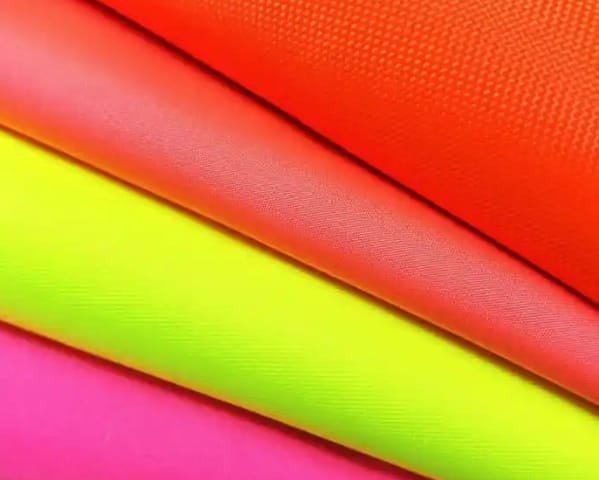
This is not a distinct fiber type but rather a base fabric enhanced through dyeing or coating processes to achieve a specific background color. International standards (such as ISO 20471) mandate that high-visibility warning garments use specific fluorescent yellow, fluorescent orange-red, or fluorescent red background colors. These colors are highly conspicuous in daylight, maximizing contrast against the background and working in tandem with reflective materials to provide “day-and-night” protection.
4. Functional Mesh Fabric
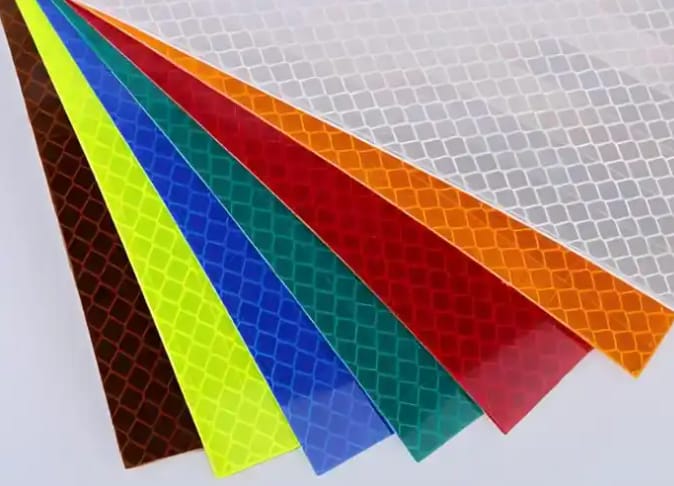
Often used in areas requiring high heat dissipation—such as the main body of reflective vests or the linings and underarm sections of detachable jackets—this fabric features a mesh structure that ensures excellent breathability. It is a crucial component for traffic police and construction workers operating in high-temperature summer conditions. Micro-prismatic Reflective Materials
II. Core Technology: The World of Retro-reflective Materials
Reflective material is the “soul” of reflective clothing; its technical principle involves reflecting light arriving from a distance back to its source along the original path, thereby ensuring clear visibility for drivers at night.
1. Glass Bead Reflective Materials (Traditional Mainstream)
Principle: Tens of thousands of high-refractive-index glass beads—each only tens of microns in diameter—are evenly embedded into a resin layer using bead-planting or coating processes. Light enters the bead, reflects off the bottom reflective layer, and is then refracted back toward the light source.
Common Forms: Reflective webbing, reflective fabric, reflective paint.
Characteristics: Mature technology, relatively low cost, soft hand-feel, and broad applicability. However, its reflective intensity (especially performance at long distances and wide angles) is generally lower than that of micro-prismatic types.
2. Micro-prismatic Reflective Materials (High-Performance Standard)
Principle: Uses precision micro-replication technology to form countless tiny trihedral right-angle prisms (similar to the microstructure of bicycle taillights) on the film surface. Light undergoes total internal reflection between three mutually perpendicular mirror surfaces, resulting in extremely high efficiency.
Common Forms: Reflective film, high-intensity reflective fabric. Often attached to base fabrics via lamination or heat transfer.
Characteristics: Reflective intensity is more than 3–5 times that of glass bead types; remains highly visible even at distances of 300–500 meters. Offers excellent water and weather resistance, though the material is relatively stiff and costs are higher. Widely used in professional sectors with stringent safety requirements, such as traffic police, firefighting, and railways.
3. Heat-Transfer Reflective Film and Graphics
Process: Micro-prismatic reflective film is pre-fabricated into patterns (such as company logos or special insignias) backed with adhesive or hot-melt glue, then heat-pressed onto the garment.
Characteristics: Patterns are intricate, durable, and wash-resistant; allows for a high degree of customization, greatly enriching the design possibilities of reflective clothing and enhancing corporate image display. 4. Smart Active-Luminescent Materials (Future Trend)
Principle: Integrates LED strips, electroluminescent (EL) panels, or photoluminescent materials into traditional reflective materials, combining “passive reflection” with “active light emission.”
Features: Capable of actively emitting visible light even in environments completely devoid of external light sources (such as tunnels or late at night), offering a qualitative leap in warning effectiveness. These materials are increasingly being applied to high-end cycling apparel and specialized occupational gear.
III. How to Choose the Right Fabric?
Selecting fabric for reflective clothing is essentially a matter of balancing functionality and cost based on the specific working environment:
Routine roadwork and sanitation/cleaning: Polyester-cotton blend base fabrics paired with glass-bead reflective tape offer a practical, cost-effective balance of comfort and basic safety.
Traffic police, highway maintenance, and emergency rescue: High-intensity micro-prismatic reflective film or fabric must be used—paired with breathable, abrasion-resistant polyester base fabric—to ensure superior visibility in complex lighting and adverse weather conditions.
Outdoor sports and cycling: A combination of lightweight, windproof fabric and high-brightness reflective strips is recommended; the inclusion of localized active-luminescent elements may also be considered.
Specialized industries (petrochemicals, electric power, etc.): In addition to the aforementioned features, specialized base fabrics with flame-retardant and anti-static properties must be selected to integrate visibility-related safety with operational safety.
