 admin
adminQuestion 1: What exactly is reflective clothing, and where is it primarily used?
Reflective clothing—also known as high-visibility warning clothing—is protective gear made by combining high-visibility fluorescent fabric with retro-reflective materials. In low-light or nighttime conditions, when a light source (such as vehicle headlights) strikes the reflective strips, the light is reflected back along its original path. This creates an intense “glowing” effect, allowing the wearer to be spotted from a great distance.
It has a wide range of applications: traffic police, sanitation workers, road construction crews, airport ground staff, port and dock workers, logistics and warehouse personnel, and night-time cyclists and runners. It is essential in any scenario where it is necessary to warn vehicles and pedestrians to steer clear in low-visibility environments. Because its use is critical for safety, the quality of reflective clothing directly impacts the wearer’s life and safety.
Question 2: Why do reflective strips reflect light? Is it the same as “glow-in-the-dark” (luminescent) material?
Many customers mistakenly believe that reflective clothing is “glow-in-the-dark” or self-illuminating; in reality, it operates on the principle of retro-reflection. The surface of the reflective strip is densely packed with high-refractive-index glass beads or micro-prismatic structures. When light enters, it is refracted and returned along the path of incidence rather than being scattered in all directions. Therefore, intense reflection is visible only when the light source is aligned with the observer’s line of sight (such as headlights shining toward a driver’s eyes). This is not self-illumination, nor does it require “absorbing light” or rely on fluorescent powder—it is completely different from the energy-storing luminescence found in “glow-in-the-dark” materials. Understanding this explains why high-quality reflective strips can provide visibility from hundreds of meters away at night.
Question 3: What safety standards should be considered when purchasing reflective clothing?
This is a frequently asked question among professional buyers. Currently, the major global standards for reflective clothing include:
EN ISO 20471 (European Union): Categorized into three classes (Class 1, 2, and 3); a higher class indicates a larger visible surface area and a higher level of protection. Vests are commonly Class 2, while long-sleeved reflective garments are usually Class 3.
ANSI/ISEA 107 (United States): Categorized into Types O, R, and P, along with corresponding classes, suitable for different work environments. GB 20653 (China): A national standard that classifies garments based on the grade of reflective materials and the performance of fluorescent fabrics.
Question 4: How should I choose between fluorescent yellow and fluorescent orange? Which is safer?
Both are high-visibility fluorescent colors; the choice depends on the background color of the work environment:
Fluorescent yellow: Highly conspicuous during the day, on overcast days, and against gloomy urban backgrounds; it is the mainstream choice for industries such as roadwork, logistics, and warehousing.
Fluorescent orange: Offers greater contrast in warm-toned environments—such as against withered grass in autumn/winter, red brick, soil, or timber stacks—making it less likely to blend into the background. Consequently, orange is commonly used in sectors like railways, forestry, and mountain rescue.
Neither is absolutely better than the other; it depends on which is more suitable for the specific work environment. If the garment needs to suit various complex backgrounds, a design combining fluorescent yellow and orange can also be used.
Question 5: As a direct manufacturer, what is the minimum order quantity (MOQ)? Is small-batch customization possible?
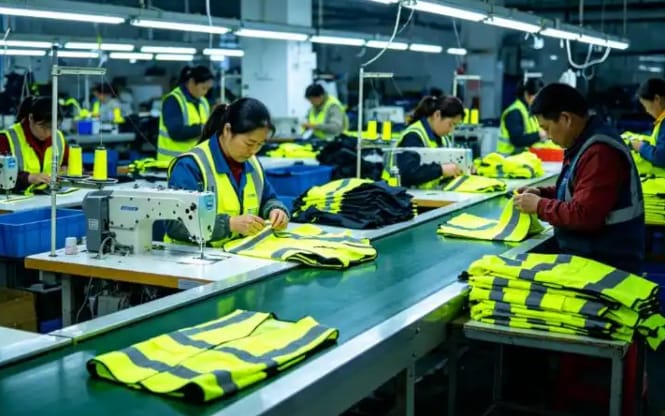
This is a primary concern for SMEs and startups. As a manufacturer with its own production facilities, Shunfa Safety operates multiple sewing lines for reflective clothing and supports flexible production. For standard, basic reflective vests, the MOQ can be as low as a single unit. For deep customization—such as adding logos, changing fabric colors, or creating new patterns—the MOQ is generally negotiated based on production complexity; however, we strive to accommodate small-batch testing needs to help clients minimize inventory risk.
Question 6: Can reflective clothing be customized with a logo? What techniques are available?
Absolutely. We support various methods—such as screen printing, heat transfer, and heat-applied vinyl (cut vinyl)—to apply company logos, ID numbers, or slogans to the garments. Please note that the logo should not excessively cover the reflective strips, as this could compromise safety certification compliance. Our technical team will evaluate your design files for compliance and offer optimization suggestions beforehand, ensuring a balance between brand visibility and safety protection.
Question 7: How should reflective clothing be washed to avoid damaging the reflective strips? How many times can it be washed?
Proper washing and maintenance directly determine the lifespan of reflective clothing. We recommend the following guidelines:
Wash inside out using a neutral detergent; do not use bleach or strongly alkaline laundry powders. Wash at a temperature not exceeding 40°C; avoid prolonged soaking. A gentle machine cycle or hand washing is recommended.
Air dry naturally; avoid high-heat tumble drying and do not iron the reflective strips.
When maintained correctly, reflective clothing used in standard working environments can withstand over 25 washes while retaining effective reflectivity. However, please note that reflective clothing is a consumable item of protective gear; it should be replaced promptly if the reflective layer peels off, the base fabric is damaged, or the fluorescent color fades significantly.
